
THE SUSTAINMENT ECOSYSTEM
Sustainment is not a single technology, industry, or engineering discipline.
It is the interaction between human systems, infrastructure, logistics, operations, and environmental constraints over time.
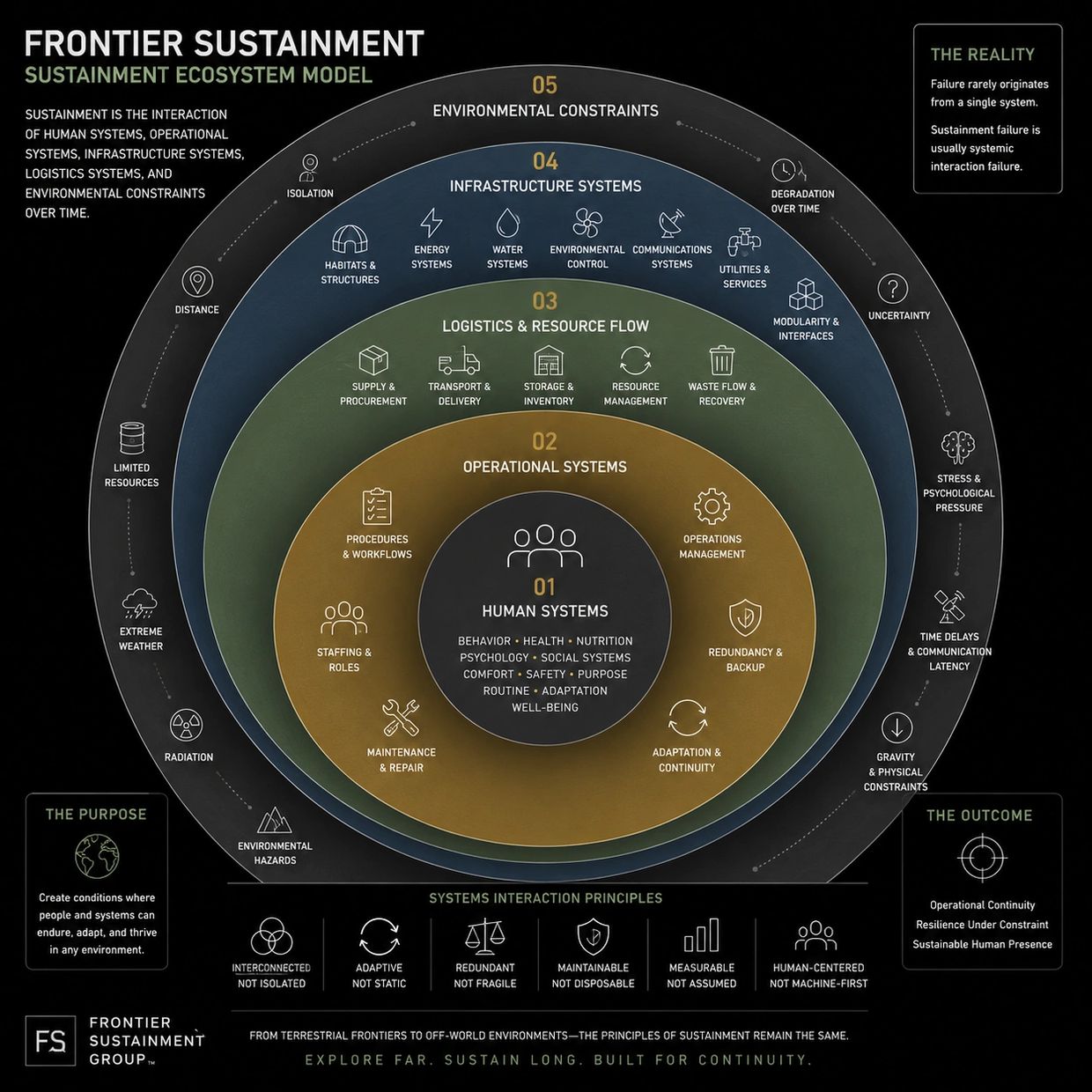
THE SUSTAINMENT ECOSYSTEM
Sustainment is not a single technology, industry, or engineering discipline.
It is the interaction between human systems, operational systems, logistics systems, infrastructure systems, and environmental pressures over time.
The Sustainment Ecosystem Model was created to illustrate how these systems continuously interact under conditions of constraint, isolation, degradation, uncertainty, and limited resources.
In frontier environments, failure rarely originates from a single issue.
Operational breakdowns are typically systemic:
a failure in logistics affects operations,
operational failures accelerate infrastructure degradation,
environmental stress impacts human performance,
and weakened human systems reduce overall continuity and resilience.
The model is intentionally layered because sustainment itself is layered.
ENVIRONMENTAL CONSTRAINTS
Every sustainment system operates within environmental pressure.
Distance, isolation, resource limitations, delayed support, environmental exposure, degradation over time, uncertainty, and physical constraints all shape how systems must function.
These pressures are not unique to space environments.
Many already exist in:
- remote operations
- disaster environments
- military logistics
- offshore infrastructure
- extreme weather operations
- field construction
- isolated industrial systems
The frontier already exists on Earth.
INFRASTRUCTURE SYSTEMS
Infrastructure creates survivable environments.
Habitats, utilities, environmental controls, water systems, structures, communications systems, and modular interfaces all exist to support continuity of human life and operations.
But infrastructure is not static.
All infrastructure:
- degrades
- requires maintenance
- experiences stress
- interacts with environmental forces
- accumulates operational wear over time
Sustainment requires continuous adaptation, repairability, maintainability, and operational awareness.
LOGISTICS & RESOURCE FLOW
No long-duration system survives without resource continuity.
Food, packaging, inventory, storage, transport, replenishment, waste recovery, and resource management determine whether systems remain functional under constraint.
Logistics is not a support system.
Logistics IS the system.
As environments become more remote and resources become more constrained, efficiency, redundancy, recoverability, and modularity become increasingly critical.
OPERATIONAL SYSTEMS
Infrastructure alone does not create continuity.
Operational systems determine whether environments remain functional over time.
Procedures, workflows, maintenance cycles, staffing models, adaptation protocols, redundancy planning, and repair systems all shape long-duration survivability.
The future of sustainment will depend not only on technology —
but on the operational ecosystems surrounding technology.
HUMAN SYSTEMS
At the center of every sustainment environment are humans.
Human performance is shaped by:
- stress
- fatigue
- routine
- nutrition
- comfort
- psychology
- safety
- environmental interaction
- social systems
- purpose
- behavioral continuity
Technology alone cannot sustain human presence.
Human-centered operational design will become one of the defining challenges of long-duration frontier environments.
SYSTEMIC INTERACTION
The Sustainment Ecosystem Model is built around a central principle:
Sustainment failure is usually systemic interaction failure.
Rarely does a single component determine success or collapse.
Instead, continuity emerges from how systems interact, adapt, recover, and evolve together over time.
The future of frontier habitation may ultimately depend less on isolated technological breakthroughs —
and more on whether complex operational ecosystems can remain resilient under pressure.
EARTH IS ALREADY A FRONTIER LABORATORY
For generations, frontier thinking has been associated primarily with distant environments:
space habitats,
planetary exploration,
remote colonies,
and future off-world systems.
But many of the operational pressures associated with frontier environments already exist here on Earth.
Isolation.
Resource limitations.
Infrastructure degradation.
Supply instability.
Environmental exposure.
Human fatigue.
Operational continuity under pressure.
These are not hypothetical conditions.
They are already present across:
- remote infrastructure systems
- disaster response operations
- industrial facilities
- offshore environments
- military logistics
- food systems
- delivery networks
- packaging ecosystems
- construction operations
- field maintenance systems
- high-pressure operational environments
The frontier is not merely a destination.
It is a condition.
Restaurants, logistics systems, infrastructure networks, and operational ecosystems may appear disconnected on the surface.
But beneath them exists a shared reality:
all sustainment systems depend on continuity.
They require:
- resource flow
- maintenance
- human coordination
- operational resilience
- environmental adaptation
- recoverability
- redundancy
- workflow stability
- infrastructure interaction
When continuity weakens, systems begin to degrade.
Sometimes slowly.
Sometimes invisibly.
Sometimes catastrophically.
Earth already provides living laboratories for understanding how operational ecosystems function under stress.
Every delayed shipment,
every infrastructure failure,
every workflow breakdown,
every degraded environment,
every supply disruption,
and every operational recovery effort reveals something about long-duration sustainment.
The future of frontier habitation may depend less on inventing entirely new operational realities —
and more on understanding the systems humans already struggle to sustain today.
The same principles that shape:
- food continuity
- waste management
- workflow efficiency
- infrastructure maintenance
- logistics resilience
- packaging systems
- operational redundancy
- environmental survivability
may ultimately shape the future of:
- lunar habitats
- remote research systems
- orbital environments
- autonomous infrastructure
- long-duration habitation systems
- resource-constrained settlements
Frontier Sustainment Group exists to explore those intersections.
Because the future of civilization may not begin with escape from Earth.
It may begin with better understanding the systems that already sustain human life here now.
PRINCIPLES OF FRONTIER SUSTAINMENT
Sustainment is not a single system.
It is the continuous interaction between infrastructure, logistics, operations, environmental pressures, and human adaptability over time.
The following principles form the operational philosophy underlying Frontier Sustainment Group.
Exploration Is Temporary. Sustainment Is Civilization.
Exploration begins the journey. Sustainment determines whether civilization endures.
Human Systems Fail Before Technology Fails.
Stress, fatigue, operational overload, fragmentation, and behavioral breakdown often emerge long before total technological collapse.
Sustainment Is Systemic.
No operational ecosystem exists in isolation. Human systems, infrastructure, logistics, operations, and environmental pressures continuously interact.
Earth Is Already a Frontier Laboratory.
Remote operations, infrastructure systems, logistics networks, restaurants, disaster environments, field operations, and construction ecosystems already reveal how sustainment systems adapt and fail under pressure.
Maintainability Matters More Than Novelty.
Long-duration systems are defined less by breakthrough technology and more by repairability, continuity, adaptability, and operational resilience.
Logistics Determines Survivability.
No environment can sustain human presence without continuous movement of resources, materials, energy, food, waste, and operational supplies.
Infrastructure Is Never Static.
All built environments degrade over time. Sustainment requires continuous maintenance, adaptation, inspection, and operational awareness.
Complexity Without Continuity Is Fragility.
Systems that cannot be maintained, repaired, understood, or operationally supported become vulnerable regardless of technological sophistication.
Redundancy Is Resilience.
Backup systems, alternative pathways, recoverability, and operational flexibility are essential to long-duration survivability.
Operational Continuity Is a Design Discipline.
Procedures, workflows, staffing structures, maintenance cycles, and adaptive systems must be intentionally designed — not improvised after failure occurs.
Human-Centered Environments Shape Performance.
Habitability includes psychology, comfort, nutrition, routine, safety, environmental interaction, and behavioral continuity — not simply shelter.
Sustainment Requires Interdisciplinary Thinking.
The future will require collaboration between engineers, operators, logisticians, behavioral thinkers, infrastructure designers, packaging specialists, and maintainability strategists.
Frontier Environments Amplify Weaknesses.
Isolation, delay, resource limitations, environmental exposure, and uncertainty accelerate operational failures that might otherwise remain manageable.
Systems Degrade Gradually Before They Collapse Suddenly.
Most failures emerge through accumulation:
deferred maintenance,
resource instability,
fatigue,
small operational compromises,
and interaction breakdowns over time.
Sustainment Is Adaptation Under Pressure.
Resilient systems are not systems that avoid stress.
They are systems capable of continuously adapting to stress while maintaining continuity.
Infrastructure Shapes Civilization.
The environments humans build ultimately shape behavior, resilience, operations, continuity, and survivability.
The Future Belongs to Systems That Endure.
Long-duration civilization will depend less on rapid expansion alone and more on the ability to sustain stable, resilient, maintainable operational ecosystems over time.
THE MANIFESTO
Humanity has long celebrated exploration.
We celebrate discovery, expansion, innovation, movement, and the pursuit of new frontiers. We build rockets, launch satellites, cross oceans, construct cities, and continuously push beyond the limits of what once seemed possible.
But exploration alone does not create civilization.
Civilization emerges from systems that endure.
From infrastructure that survives.
From logistics that adapt.
From environments humans can continuously inhabit.
From operational continuity maintained under pressure, uncertainty, degradation, and constraint.
The future will not be defined solely by where humanity goes.
It will be defined by what humanity can sustain.
Modern thinking often separates engineering from operations, logistics from infrastructure, technology from human behavior, and innovation from long-term maintainability.
But sustainment does not exist in isolated disciplines.
Sustainment is systemic.
Every long-duration environment — whether a remote research station, offshore platform, disaster zone, dense urban system, industrial operation, military outpost, or future off-world habitat — depends on the continuous interaction between:
- human systems
- operational systems
- infrastructure systems
- logistics systems
- environmental constraints
When these systems function together, continuity becomes possible.
When they fragment, systems degrade.
Failure rarely begins as a single catastrophic event.
More often, sustainment failure emerges gradually through accumulated interaction breakdowns:
deferred maintenance,
resource instability,
operational fatigue,
environmental stress,
logistical disruption,
infrastructure degradation,
and weakened human adaptability.
Sustainment is not the absence of failure.
Sustainment is the continuous ability to adapt to failure.
Frontier Sustainment Group was created around a simple but increasingly important belief:
Earth is already a frontier systems laboratory.
The challenges associated with future frontier environments are not entirely hypothetical.
Many already exist across terrestrial systems operating under pressure:
- remote operations
- infrastructure networks
- restaurants and hospitality systems
- supply chains
- packaging ecosystems
- disaster response environments
- field logistics
- construction systems
- delivery infrastructure
- industrial maintenance systems
- resource-constrained operational environments
These are not disconnected industries.
They are sustainment ecosystems.
Each reveals how humans interact with systems, how continuity is maintained, how environments degrade over time, and how operational resilience is either strengthened or lost.
The frontier is not merely a destination.
It is a condition.
As environments become more remote, interconnected, and resource-constrained, sustainment becomes increasingly dependent on interdisciplinary thinking.
The future will not belong solely to isolated technical disciplines.
It will require collaboration between:
- engineers
- operators
- logisticians
- infrastructure designers
- behavioral thinkers
- environmental specialists
- packaging and resource-flow experts
- maintainability strategists
- systems integrators
Technology alone cannot sustain civilization.
Human-centered operational ecosystems sustain civilization.
Modern culture often celebrates novelty.
But frontier environments reward continuity.
Systems that survive long durations are not necessarily the most advanced.
They are the most maintainable.
The most adaptable.
The most repairable.
The most operationally resilient.
Maintainability may ultimately matter more than innovation.
Redundancy may matter more than optimization.
Operational clarity may matter more than technological complexity.
The future of sustainment will depend not only on breakthrough inventions —
but on whether complex systems can continuously function under real-world pressure over time.
Human systems remain at the center of all sustainment environments.
Habitability is not simply shelter.
It includes:
routine,
nutrition,
psychological continuity,
behavioral stability,
comfort,
safety,
social interaction,
workflow,
purpose,
and environmental relationship.
Infrastructure shapes behavior.
Operations shape resilience.
Environments shape human performance.
Long-duration survivability is ultimately a human systems challenge.
Frontier Sustainment Group exists to explore these interactions.
Not as a conventional aerospace company.
Not as speculative futurism.
Not as a singular technology initiative.
But as an interdisciplinary operational framework focused on:
- sustainment
- continuity
- resilience
- infrastructure
- logistics
- maintainability
- human-centered systems
- operational ecosystems under constraint
We believe the future requires a broader conversation about how civilization functions under pressure.
We believe sustainment deserves greater attention than expansion alone.
We believe the systems that quietly endure may ultimately matter more than the systems that simply move faster.
The future will not be shaped solely by exploration.
It will be shaped by continuity.
By operational resilience.
By maintainable systems.
By adaptive infrastructure.
By human-centered environments capable of surviving under pressure across long durations of time.
Exploration is temporary.
Sustainment is civilization.
INVITATION TO DIALOGUE
Frontier Sustainment Group welcomes dialogue with researchers, operators, engineers, designers, institutions, and interdisciplinary thinkers exploring sustainment, continuity, resilience, infrastructure, logistics, and human-centered systems in frontier environments.
The future of civilization will depend not only on exploration —
but on the systems capable of enduring beyond it.
Copyright © 2026 Frontier Sustainment Group - All Rights Reserved.
A Strategic Advisory Division of The Consultancy, LLC
This website uses cookies.
We use cookies to analyze website traffic and optimize your website experience. By accepting our use of cookies, your data will be aggregated with all other user data.